
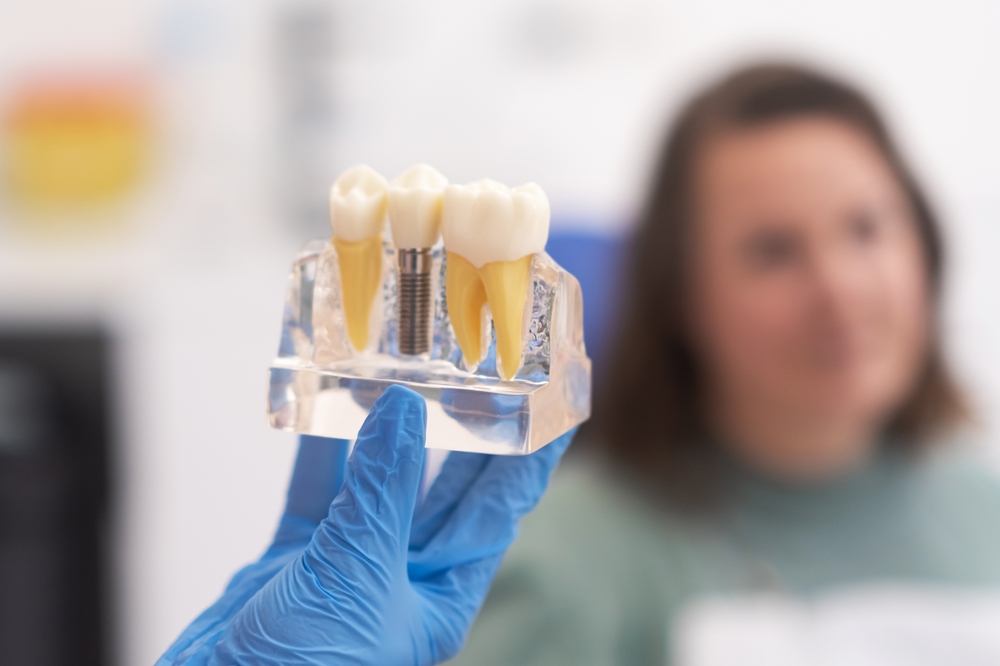
If you’re missing several teeth or an entire arch, two options usually come up first: dentures or dental implants. Both restore your ability to eat, speak, and smile, but they work in fundamentally different ways, and that difference matters a great deal over the long run. Here’s how traditional dentures compare to implant-based solutions, and where each fits for patients in Dallas, Stroudsburg, North Pocono, North Scranton, Eynon, West Scranton, Mt. Pocono, Throop, and Lake Winola, PA.
What Is the Difference Between Dentures and Dental Implants?
Traditional dentures are removable appliances that rest on top of the gums, held in place with suction or adhesive. Dental implants are titanium posts surgically placed into the jawbone, where they fuse with the bone and act as an artificial tooth root supporting a crown, bridge, or full-arch prosthesis. That single distinction, sitting on the gums versus fusing with the bone, drives nearly every difference in comfort, stability, and long-term oral health between the two options.
How Do Traditional Dentures Work?
Full dentures replace an entire arch of missing teeth, while partial dentures fill in gaps around remaining natural teeth. They’re typically less expensive upfront and don’t require surgery, which makes them accessible for many patients. However, because dentures rest on the gums rather than the bone, they don’t stop the jawbone from gradually shrinking after tooth loss, a process called bone resorption. Over time, this can cause dentures to loosen, shift while eating or speaking, and require regular relining or replacement.
How Do Dental Implants Work?
A dental implant replaces the entire tooth, root and all, rather than just the visible portion. After the implant post is placed in the jawbone, it fuses with the bone over the following months through a process called osseointegration. Because the implant stimulates the bone the same way a natural tooth root does, it helps preserve jaw structure and facial shape instead of allowing it to deteriorate. iSmile offers a full range of implant solutions, from single implants and implant-supported bridges to full-arch dental implants, so the right structure can be matched to each patient’s needs.
Key Differences Between Dentures and Dental Implants
Stability: Dentures can shift, click, or slip, particularly when eating or speaking, while implants are fixed securely in place with no movement.
Bone health: Dentures don’t prevent bone loss in the jaw. Implants stimulate the bone and help preserve its structure and your facial shape over time.
Comfort: Denture wearers often experience irritation, sore spots, or rubbing against the gums. Implants eliminate this because they don’t rely on the gum tissue for support.
Diet: Dentures can make certain sticky or hard foods difficult to eat. Implants restore near-natural bite strength, allowing for a broader range of foods.
Maintenance: Dentures require nightly removal, cleaning, and often adhesive. Implants are cared for like natural teeth, with regular brushing and flossing and no special products needed.
Longevity: Dentures typically need relining or replacement every five to seven years. Implants, when properly maintained, are built to last for decades, with research showing roughly a 96% success rate after ten years.
Is There an Implant Option That Still Feels Like a Denture?
For patients who want a full-arch solution but aren’t sure a fixed restoration is right for them, implant-supported dentures offer a middle ground. A small number of implants anchor the denture securely in place, eliminating slipping and the need for adhesive while still preserving jawbone health. For patients ready for a permanent, non-removable solution, full-arch dental implants use as few as four implants per arch to support a fixed set of replacement teeth that function like natural teeth and never come out.
Who Tends to Choose Traditional Dentures?
Traditional dentures are sometimes the right fit for patients who have experienced significant bone loss and aren’t yet candidates for implants, or who need a lower upfront cost or a faster timeline. That said, many patients who start with traditional dentures find that ongoing fit issues and bone loss eventually lead them to explore implant-supported alternatives.
Who Tends to Choose Dental Implants?
Implants are typically the better long-term choice for patients who want the closest possible match to natural tooth function, who are focused on preserving their jawbone and facial structure, or who are tired of the adjustments, sore spots, and slipping that come with removable dentures. Bone loss doesn’t automatically rule out implants, either. iSmile’s team can often build a stable foundation through supportive procedures like bone grafting for patients who need it.
How Do Costs Compare?
Traditional dentures usually cost less initially, but that gap narrows over time once relines, adjustments, and periodic replacements are factored in. Dental implants involve a higher upfront investment due to the surgical placement and healing period, but their durability often makes them the more cost-effective option over a patient’s lifetime. iSmile offers flexible financing options, including third-party financing through Proceed Finance and CareCredit, to help make implants accessible regardless of budget.
Frequently Asked Questions
Are dental implants better than dentures? Implants generally offer superior stability, comfort, and bone preservation, while traditional dentures are more affordable upfront and don’t require surgery. The right choice depends on your bone health, budget, and long-term goals.
Can I switch from dentures to implants later? Yes. Many patients start with removable dentures and later transition to implant-supported dentures or full-arch implants once they’re ready, or once ongoing fit problems make a change appealing.
Do implants feel like real teeth? Most patients say implants look, feel, and function very similarly to natural teeth since they’re anchored in the jawbone rather than resting on the gums.
Will I need bone grafting for implants? Not always. Bone grafting is only needed when there isn’t enough jawbone density to support an implant, which your consultation and imaging will determine.
How long does the transition from dentures to implants take? It varies by case, but the process generally takes a few months to allow time for the implant to heal and fuse with the jawbone before the final restoration is placed.
Is getting dental implants painful? Most patients experience only mild discomfort for a few days after surgery, especially with modern techniques and sedation options like IV sedation available at iSmile.
Find the Right Fit at iSmile
Choosing between dentures and dental implants comes down to your bone health, budget, and goals for long-term comfort and function. The team at iSmile offers a complimentary consultation to walk through every option available to you. Schedule your consultation today or call (570) 876-4488 to find the tooth replacement solution that’s right for you.